


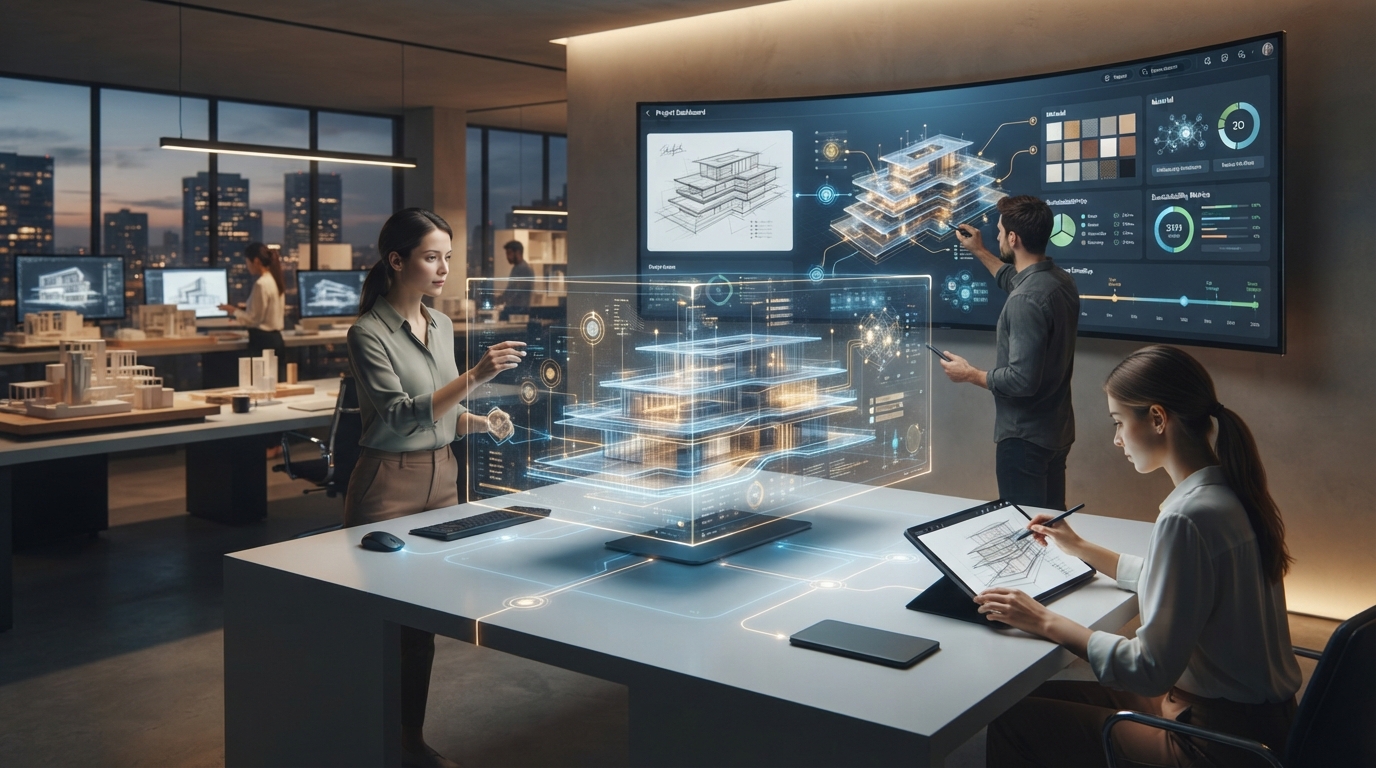


Software has long been integral to architecture and interior design. Practitioners today use specialised technologies for drafting, modelling, rendering, documentation, sourcing and project management. Each tool serves a specific purpose, but the overall process remains fragmented.
The larger opportunity for AI in design may not be another generative feature added to an existing software product. It could be a shift towards AI-native workflows that understand context across multiple stages of a project.
A project may begin with information gathering and move through concept development, space planning, visualisation, material selection, costing and execution. Technology supports each stage, yet information often has to be manually transferred from one application to another.
Artificial intelligence is beginning to challenge this model.
The larger opportunity for AI in design may not be another generative feature added to an existing software product. It could be a shift towards AI-native workflows that understand context across multiple stages of a project.
The distinction matters. Generating an image from a text prompt can be useful, but it represents only one part of the design process. A designer must also account for spatial constraints, functional requirements, client preferences, materials, budgets and practical limitations. The value of AI lies in connecting these considerations, allowing information generated at one stage to inform what happens next.
Consider a residential project. Requirements captured during an initial conversation could inform a space plan. That space plan could drive visualisations, which could then inform product and material discovery. The same information could eventually contribute to bills of materials, quotations and execution documentation.
The workflow becomes less about moving information between applications and more about maintaining a continuous understanding of the project.
This points to a fundamental shift in how design technology could be structured.
Historically, the technology stack has been organised around functions: one application for modelling, another for rendering, another for presentations, sourcing or project management. AI introduces the possibility of organising technology around workflows and outcomes instead.
Designers do not think about projects as a sequence of software applications. They think about creating spaces that meet aesthetic, functional and commercial requirements. Technology has traditionally required them to translate that intent into the language of multiple platforms.
AI could increasingly take on some of that translation.
Natural language, visual references and project information can become interfaces through which designers access multiple capabilities. Instead of treating each task as an isolated operation, an AI-native system can use the context of the broader project to support decisions across the workflow.
This does not mean that every part of design becomes automated.
Design is fundamentally judgment-oriented. Understanding what a client wants, balancing competing requirements, developing an aesthetic direction and deciding what works within a particular space cannot be reduced to generating a solution.
In fact, AI may make human judgment more valuable.
As repetitive and operational work becomes increasingly automated, designers can spend more time exploring alternatives, evaluating trade-offs and refining the final outcome. The opportunity is not to automate design itself, but to change how designers allocate their time and expertise.
The challenge, however, is context.
A visually impressive design that ignores dimensions, budgets, product availability or execution constraints has limited practical value. For AI to become genuinely useful in professional design environments, it needs to understand more than what something should look like. It needs to understand why it works, what it depends on and what happens next.
This is where the difference between an AI feature and an AI-native system becomes important.
An AI feature improves an existing task. An AI-native workflow is designed around the relationships between tasks. It allows information, decisions and constraints to carry forward instead of being recreated at every stage.
That distinction could reshape the design technology stack.
As design becomes more digitally connected, the boundaries between design software, product discovery, visualisation and execution could begin to blur. Product databases, material libraries, visualisation engines and project information could increasingly interact within a single workflow.
This could also create a new basis for competition in design technology. The value of a platform may increasingly depend not on the number of AI features it offers, but on how effectively it understands and connects the context of a project.
For an industry whose technology stack has become increasingly specialised over decades, AI could introduce a countervailing force: integration around the way professionals actually work.
The next stage of innovation, therefore, may not simply be about adding AI to every existing design tool. It may require asking a more fundamental question:
What would the design process look like if the workflow itself were built around AI?
The answer could change not only the tools designers use, but the way creative intent moves from an initial idea to a real, executable business solution.

Guest author Natasha Jain is the Founder and CEO of Agent B Studio, an AI-powered space and product visualization platform designed specifically for interior designers, architects, furniture brands, and real estate professionals. Any opinions expressed in this article are strictly those of the author.